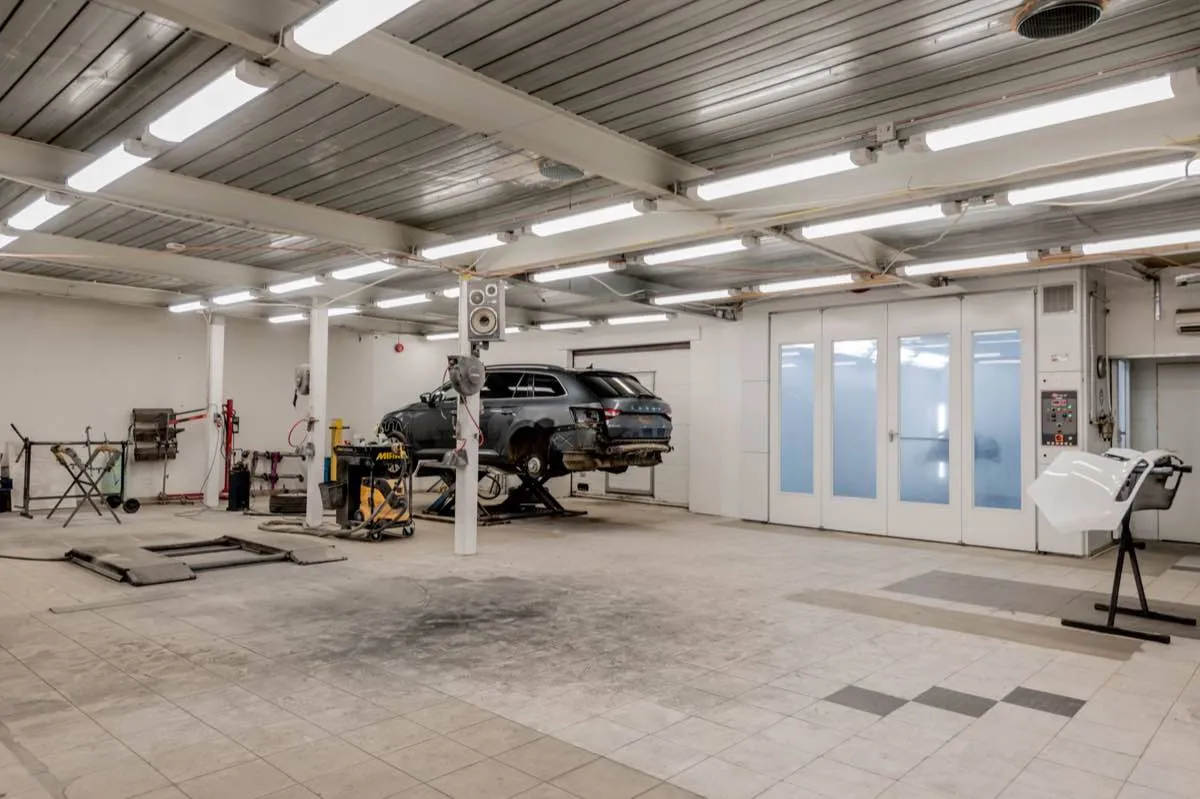
Short version: an epoxy basement floor is a great upgrade — if your slab is dry. Basements live below ground, and the thing that quietly kills basement coatings isn't traffic or spills. It's water vapor pushing up through the concrete. Test for that first, and epoxy will look sharp and last 10 to 20 years. Skip the test, and you're repainting the floor by next winter.
Here's the part the big-box display doesn't mention while it's selling you a $50 kit: your basement slab sits against damp soil, with no airflow underneath. A garage slab gets to breathe. A basement slab is basically a lid on a bucket of dirt. That one difference is why the same epoxy that thrives in a garage can peel off a basement in a season.
Is epoxy good for a basement floor?
Yes, on a dry slab it's one of the best floors you can put down there. You get a gap-free, mold-resistant, wipe-it-clean surface with no grout lines for mildew to colonize and nothing to soak up a leak. For a finished basement, a home gym, or a laundry room, it beats carpet (which molds) and tile (which cracks and grows grout mildew) for durability and upkeep.
The honest caveats:
- It's hard and cold underfoot. Great for a workshop, less cozy for a TV room without a rug.
- A high-gloss finish gets slick when wet, so add an anti-slip grit if the space ever sees water.
- It is completely unforgiving about moisture and prep. That's the whole ballgame, so let's talk about it.
The moisture test that decides everything
This is the section every "how to epoxy your basement" article skips, and it's the only one that actually matters. Concrete looks solid, but it's a sponge. Ground water wicks up into the slab and evaporates off the surface as vapor. You can't see it. Lay a film of epoxy over it and that vapor gets trapped, builds pressure, and pushes the coating off the floor in sheets. Contractors call it hydrostatic vapor pressure. You'll call it "why is my new floor bubbling."
So before anyone opens a bucket, run the test. It's free and takes a day.
The plastic-sheet test (do this yourself):
- Tape a square of clear 4-mil poly flat to the bare slab. ASTM D4263 asks for at least 18 by 18 inches; a 2-foot square is simply easier to read.
- Seal all four edges with tape so it's airtight.
- Wait at least 16 hours — morning to morning is the practical version. Longer is fine and catches a slower slab.
- Condensation under the plastic, or a dark damp patch on the concrete, means you have a moisture problem. A bone-dry slab means you're clear.
Do this in two or three spots, including the middle of the room and near any exterior wall. That's the ASTM D4263 plastic sheet method and it costs you a strip of tape. Be clear about what it is, though: a yes/no indicator. The standard gives you a look, not a number.
If you want a real number, that's where a pro comes in. We run a calcium chloride test (it measures how many pounds of moisture come through 1,000 square feet in 24 hours) or an in-slab RH probe. Most standard epoxy primers want that figure under about 3 pounds — and that ceiling is the coating manufacturer's, printed on its data sheet. No ASTM test method sets it. Above it, you don't cancel the project. You switch to a moisture-mitigating primer or a vapor-barrier system built for exactly this, then coat over it. There's a right answer for a damp basement; it's just not the $50 kit.
The takeaway: epoxy doesn't fail in basements because epoxy is bad. It fails because nobody tested the slab. Fifteen minutes with a plastic square saves a four-figure redo.
Epoxy basement floor cost
Prep and product drive the price, not the square footage alone. Here's what the real tiers look like, materials and all:
| Option | Cost (per sq ft) | 500 sq ft basement | Reality check |
|---|---|---|---|
| Big-box DIY kit | ~$0.50–$1 | ~$250–$500 | Thin, single-coat, no moisture help. Peels fast on a damp or unground slab. |
| Better DIY / mid-grade kit | ~$1.50–$3 | ~$750–$1,500 | Includes a primer; still only as good as your prep. |
| Pro standard coating | $3–$7 | $1,500–$3,500 | Diamond-ground slab, moisture control, real topcoat, warranty. |
| Pro metallic or polyaspartic | $7–$12 | $3,500–$6,000 | Showpiece finish or fast-cure; UV-stable and toughest. |
Notice the gap between a big-box kit and a pro job isn't really the epoxy. It's the prep and the moisture control, and that's where 80% of the labor (and the entire lifespan of the floor) actually lives.
Which brings us to the opinion we'll get emails about.
The $50 kit is a trap on a basement slab
A big-box DIY kit poured over an unground or damp basement slab peels within a year. Every time. It's the single most common failure we get called to fix. The kit isn't fraudulent — that same product can do fine on a properly prepped, dry garage floor. But basements break both of its rules at once: the slab is often faintly damp, and nobody diamond-grinds it first. Acid-etching from a bottle doesn't open the concrete enough for the coating to bite. So it lifts.
If you're going DIY anyway, spend your money in the right order: rent a diamond grinder (not acid), do the plastic-sheet test, and buy a kit with a real moisture primer. The coating is the cheap part. The bond is everything.
When to just seal it instead
Sometimes epoxy is the wrong tool, and an honest floor guy will tell you so. If your plastic test comes back damp and you're not ready to pay for a mitigation system, a breathable penetrating concrete sealer is the smarter, cheaper move. It soaks into the slab instead of sitting on top, so trapped vapor doesn't blow it off. It won't give you the glossy showroom look, but it dust-proofs the floor and it won't peel.
The trade-off in one line: a sealer breathes and hides; epoxy shines and protects — but only over a dry slab. Match the floor to the slab you actually have, not the Pinterest board.
The scene we walk into every month
Picture it: a Fresno homeowner finishes the basement, rolls a big-box epoxy over the old slab on a Saturday, and it looks fantastic on Sunday. Then the the Central Valley humidity does its thing. By spring there's a bubble near the wall, and one determined tug turns your beautiful floor into a peel-and-stick project you didn't sign up for. Your basement goes from finished space to a floor that looks like it survived a crime scene — one big damp stain and a corner curling up like old wallpaper.
None of that is bad luck. It's an untested slab. And it's completely avoidable with the steps above.
The bottom line
An epoxy basement floor is durable, cleanable, and genuinely nice to live with — when the slab passes the moisture test and the concrete gets properly ground first. Get those two things right and you'll forget about the floor for a decade. Get them wrong and you'll redo it before the year's out.
If you'd rather not gamble your weekend on a plastic square, Fresno Elite Epoxy Flooring tests the slab before we quote and installs the right system for what your basement is actually doing — from a standard garage-and-basement floor coating, to a moisture-tolerant, fast-curing polyaspartic system, to tearing out and redoing a floor that a previous kit left peeling. Free estimate and a real moisture test across Fresno and the Central Valley: call (877) 335-4158.
Ready for a free quote in Fresno?
Fresno Elite Epoxy Flooring — free estimate, clear scope, no pressure. Use the form on this page or jump to the homepage quote.
Related services in Fresno
Fresno Elite Epoxy Flooring money pages — go straight to the service you need.
- Concrete Grinding & Shot Blasting →
Fresno Elite Epoxy Flooring provides concrete grinding and surface prep for Valley slabs before any resin or polish work begins. Valley concrete hides dust, irrigation stains, and soft paste under a skin that looks fine until coating peels.
- Moisture Vapor Mitigation →
Moisture vapor mitigation is the step that separates a floor that lasts from a floor that blisters, and it gets skipped constantly because it is invisible and it costs money before anything looks like progress. Concrete is porous.
- Flake Floor Systems →
Fresno Elite Epoxy Flooring installs flake epoxy floors for Valley garages and light commercial bays that want hide-the-dust texture. Flake is popular here because valley dust and hard-water spots show less than on a solid field under bright afternoon light.
- Polyaspartic & Polyurea Coatings →
Polyaspartic and polyurea coatings solve the two problems epoxy cannot: sunlight and downtime. Polyaspartic is an aliphatic polyurea, and aliphatic chemistry does not amber under ultraviolet light the way epoxy inevitably does, so any floor that sees sun through a roll-up door, a skylight or a storefront window needs one on top or it will yellow and eventually chalk.
- Solid Color Epoxy Coatings →
Fresno Elite Epoxy Flooring pours solid-color epoxy when Valley clients want a simple, clean field without broadcast texture. A solid field is a prep exam under clear Central Valley light.
Frequently asked questions
Is it a good idea to epoxy a basement floor?
Yes, as long as the slab is dry. Epoxy gives a Fresno basement a gap-free, cleanable, mold-resistant floor for years. The catch is moisture: basements sit below grade, and vapor pushing up through the concrete is what makes coatings peel. Do a plastic-sheet test first. If the slab is dry, epoxy is a great call.
What is the average cost to epoxy a basement floor?
A big-box DIY kit runs about $0.50 to $1 per square foot in materials. A professionally installed coating runs $3 to $7 per square foot for a standard system, and $7 to $12 for metallic or polyaspartic. A typical 500 sq ft Fresno basement lands around $1,500 to $6,000 installed.
What is the downside of epoxy flooring on concrete?
The main downside is that it's unforgiving about moisture and prep. Coat a damp slab or skip the diamond grinding and it peels, usually within a year. It can also feel hard and cold underfoot, and a glossy finish gets slick when wet unless you add an anti-slip grit.
How do I know if my basement floor has a moisture problem?
Tape a 2-foot square of clear plastic to the slab, seal all four edges, and leave it 24 to 72 hours. Condensation under the plastic or a darkened patch of concrete means vapor is coming through, and a standard epoxy will not stick. For a real number, pros run a calcium chloride or RH probe test before quoting.
Is epoxy or a concrete sealer better for a basement?
A sealer is cheaper and breathes, but it soaks in and disappears. Epoxy is thicker, tougher, and actually looks finished, but it's a film that can trap or reject moisture if the slab is wet. On a dry Fresno basement slab, epoxy wins on durability and looks. On a marginally damp one, a breathable sealer or a moisture-tolerant system is the safer play.
Local context
How this applies in Fresno, CA
Every article here is written from epoxy flooring work done in Fresno and the Central Valley, so the numbers reflect local labour, permit and material costs rather than a national average. Your own job can land either side of them depending on access, the condition of what is already there, and the materials you pick — urethane cement flooring systems, novolac epoxy chemical resistance, quartz broadcast systems.
The way to turn any of this into a real answer is to have someone look at your actual situation. The free estimate is free, itemized and written down, with no deposit and no obligation. Call (877) 335-4158 or start on the Fresno Elite Epoxy Flooring homepage.
Areas Fresno Elite Epoxy Flooring covers
Fresno first, then the surrounding communities of the Central Valley. Each has its own page with local detail rather than a copy of this one:
- Clovis, CA — Fresno County, incorporated in 1912, population 120,124 at the 2020 census
- Madera, CA — Madera County, incorporated in 1907, population 66,224 at the 2020 census
- Sanger, CA — Fresno County, incorporated in 1911, population 26,617 at the 2020 census
- Reedley, CA — Fresno County, incorporated in 1913, population 25,227 at the 2020 census
- Selma, CA — Fresno County, incorporated in 1893, population 24,674 at the 2020 census
- Dinuba, CA — Tulare County, incorporated in 1906, population 24,563 at the 2020 census
Or jump to the full list of Fresno services.
More from the Fresno Elite Epoxy Flooring blog
- Epoxy Cure Time in Fresno: When Can You Park?
Epoxy cure times for Fresno, CA garages — walk on it in 24 hours, park on it in 5 to 7 days, and why temperature changes both of those numbers.
- Full Flake Epoxy Garage Floors in Fresno
Full flake epoxy garage floors in Fresno, CA — broadcast to refusal vs light scatter, chip sizes, real costs, and what to ask before you sign.
- Epoxy vs Paint on a Fresno Garage Floor
Epoxy vs paint for a Fresno, CA garage floor — film thickness, real lifespans, hot-tire resistance, and the one case where paint is the right call.
The Fresno Elite Epoxy Flooring Team
epoxy flooring specialists serving Fresno, CA
Written by the Fresno Elite Epoxy Flooring team — insured epoxy flooring pros with 15+ years serving Fresno, CA and the surrounding area.